Understanding Risk-Reward Ratio: The Beginner's Guide to Smarter Trading Decisions
If you've ever wondered why some traders stay profitable even when they lose more trades than they win, the answer often lies in one powerful concept: the risk-reward ratio. Understanding and applying this principle can fundamentally change how you approach every trade.
In this guide, we'll break down everything you need to know about risk-reward ratios in simple terms, and show you how to use our free Risk/Reward Calculator to plan your trades like a professional.
What Is the Risk-Reward Ratio?
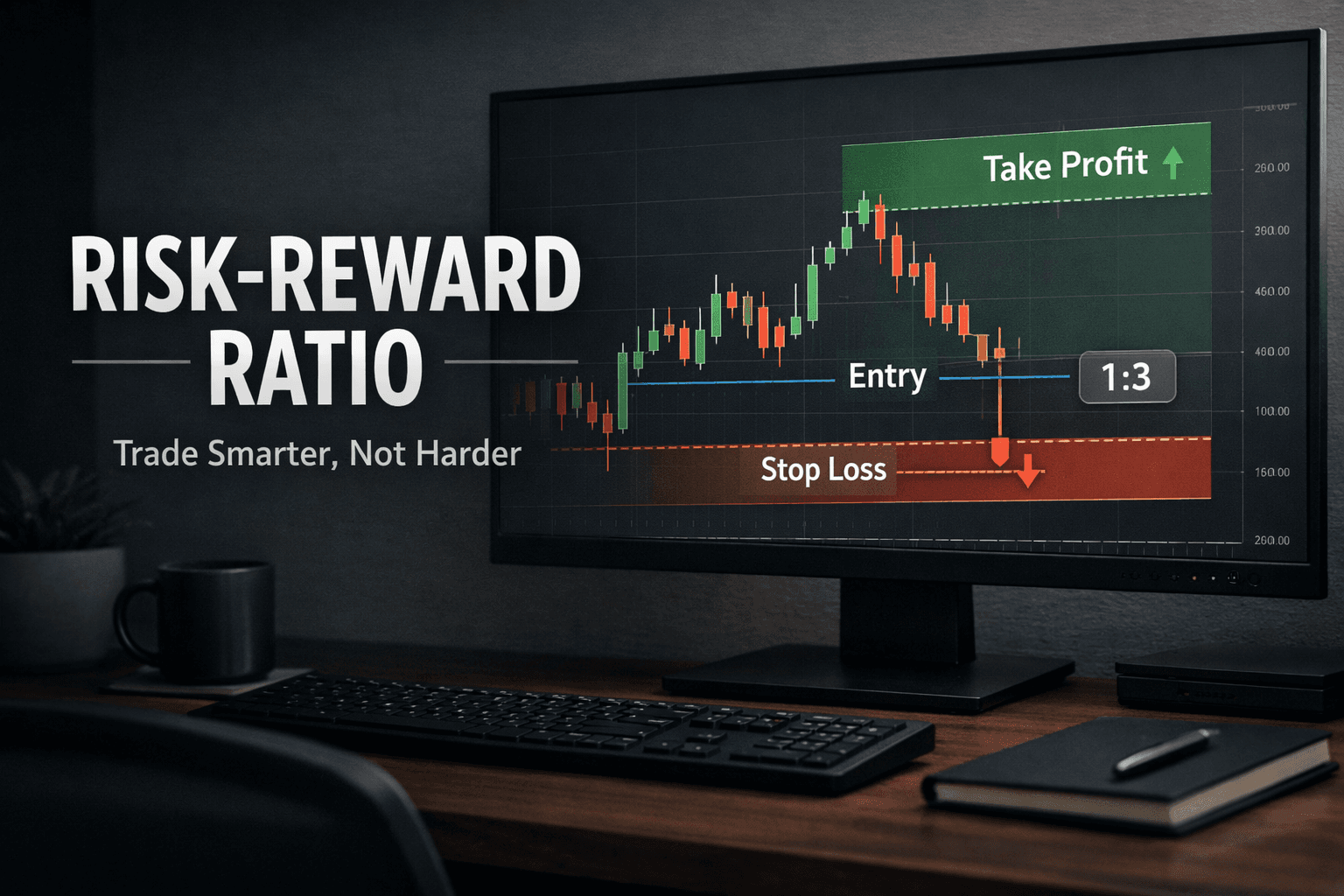
The risk-reward ratio (often written as R:R or RRR) compares how much you stand to lose on a trade versus how much you could potentially gain.
Simple Formula:
Risk-Reward Ratio = Potential Reward / Potential Risk
For example, if you risk $100 to potentially make $300, your risk-reward ratio is 3:1 (or simply "3R").
Breaking It Down Further
- Risk: The amount you'll lose if the trade goes against you (distance from entry to stop loss)
- Reward: The amount you'll gain if the trade hits your target (distance from entry to take profit)
Why Does Risk-Reward Matter So Much?
Here's a truth that surprises many new traders: you don't need to win most of your trades to be profitable.
Let's look at the math:
| Win Rate | R:R Ratio | Result After 10 Trades (risking $100 each) |
|---|---|---|
| 50% | 1:1 | Break even ($0) |
| 50% | 2:1 | Profit of $500 |
| 40% | 3:1 | Profit of $800 |
| 30% | 4:1 | Profit of $900 |
As you can see, a trader who wins only 30% of their trades can still be highly profitable if their winners are significantly larger than their losers.
The Psychology Behind Risk-Reward
Many beginners make the mistake of:
- Taking profits too early - Closing winning trades before they reach their target
- Letting losses run - Hoping losing trades will turn around
- Ignoring the ratio entirely - Entering trades without a clear plan
By committing to a minimum risk-reward ratio before entering any trade, you create a framework that protects you from emotional decision-making.
How to Calculate Risk-Reward in Forex Trading
Let's walk through a practical example using EUR/USD:
Scenario: Long (Buy) Trade
- Entry Price: 1.0850
- Stop Loss: 1.0800 (50 pips below entry)
- Take Profit: 1.0950 (100 pips above entry)
Calculation:
- Risk: 50 pips
- Reward: 100 pips
- R:R Ratio: 100 / 50 = 2:1
This means for every pip you risk, you stand to gain 2 pips.
Converting Pips to Actual Money
Knowing your R:R in pips is useful, but what really matters is the dollar amount. This depends on your position size.
Using our Risk/Reward Calculator, you can instantly see:
- Risk in pips and dollars
- Reward in pips and dollars
- The exact R:R ratio
- Position size in units
The calculator automatically converts everything to your account currency using live exchange rates.
What's a Good Risk-Reward Ratio?
There's no single "correct" ratio, but here are general guidelines:
| R:R Ratio | Assessment | Best For |
|---|---|---|
| 1:1 | Minimum acceptable | High win-rate strategies |
| 2:1 | Good | Most trading styles |
| 3:1 | Very good | Swing trading, trend following |
| 4:1+ | Excellent | Position trading, breakout strategies |
Pro Tip: Many professional traders won't take a trade unless it offers at least 2:1 reward-to-risk.
Common Mistakes to Avoid
1. Setting Unrealistic Targets
Don't place your take profit at a level the price is unlikely to reach just to get a better ratio. Your targets should be based on technical analysis (support/resistance levels, previous highs/lows, etc.).
2. Ignoring Market Structure
A 5:1 ratio means nothing if your stop loss is placed in a location where it's likely to get hit. Always place stops at logical levels.
3. Not Accounting for Spread
In forex, the spread affects both your entry and exit. Factor this into your calculations, especially on shorter timeframes.
4. Changing Your Plan Mid-Trade
Once you've set your stop loss and take profit based on your analysis, stick to the plan. Moving your stop loss further away or taking profits early defeats the purpose.
How to Use the TradeLens Risk/Reward Calculator
Our free Risk/Reward Calculator makes planning trades simple:
- Select your trade direction (Long or Short)
- Choose your currency pair (EUR/USD, GBP/USD, USD/JPY, etc.)
- Enter your entry price (where you plan to enter)
- Set your stop loss (where you'll exit if wrong)
- Set your take profit (your target price)
- Enter your position size (in standard lots)
- Select your account currency
The calculator instantly shows you:
- Risk and reward in pips
- Risk and reward in your account currency
- The reward-to-risk ratio
- Total position size in units
Putting It All Together: A Complete Trade Plan
Before entering any trade, answer these questions:
- Where will I enter? (Entry price)
- Where will I exit if I'm wrong? (Stop loss)
- Where will I take profits? (Take profit)
- What's my risk-reward ratio? (Should be at least 2:1)
- How much am I risking in dollars? (Should be 1-2% of account)
- What's my position size? (Calculated based on risk)
If you can't answer all these questions clearly, you're not ready to take the trade.
The Bottom Line
The risk-reward ratio is one of the most important concepts in trading. It's not about being right all the time—it's about making sure your winners outweigh your losers over time.
By consistently applying favorable risk-reward ratios and using tools like our Risk/Reward Calculator, you give yourself a mathematical edge that compounds over hundreds of trades.
Remember: Professional traders don't gamble. They calculate, plan, and execute with precision. The risk-reward ratio is your first step toward trading like a pro.
Ready to plan your next trade? Try our free Risk/Reward Calculator and see exactly what you stand to gain—and lose—before you click that buy or sell button.