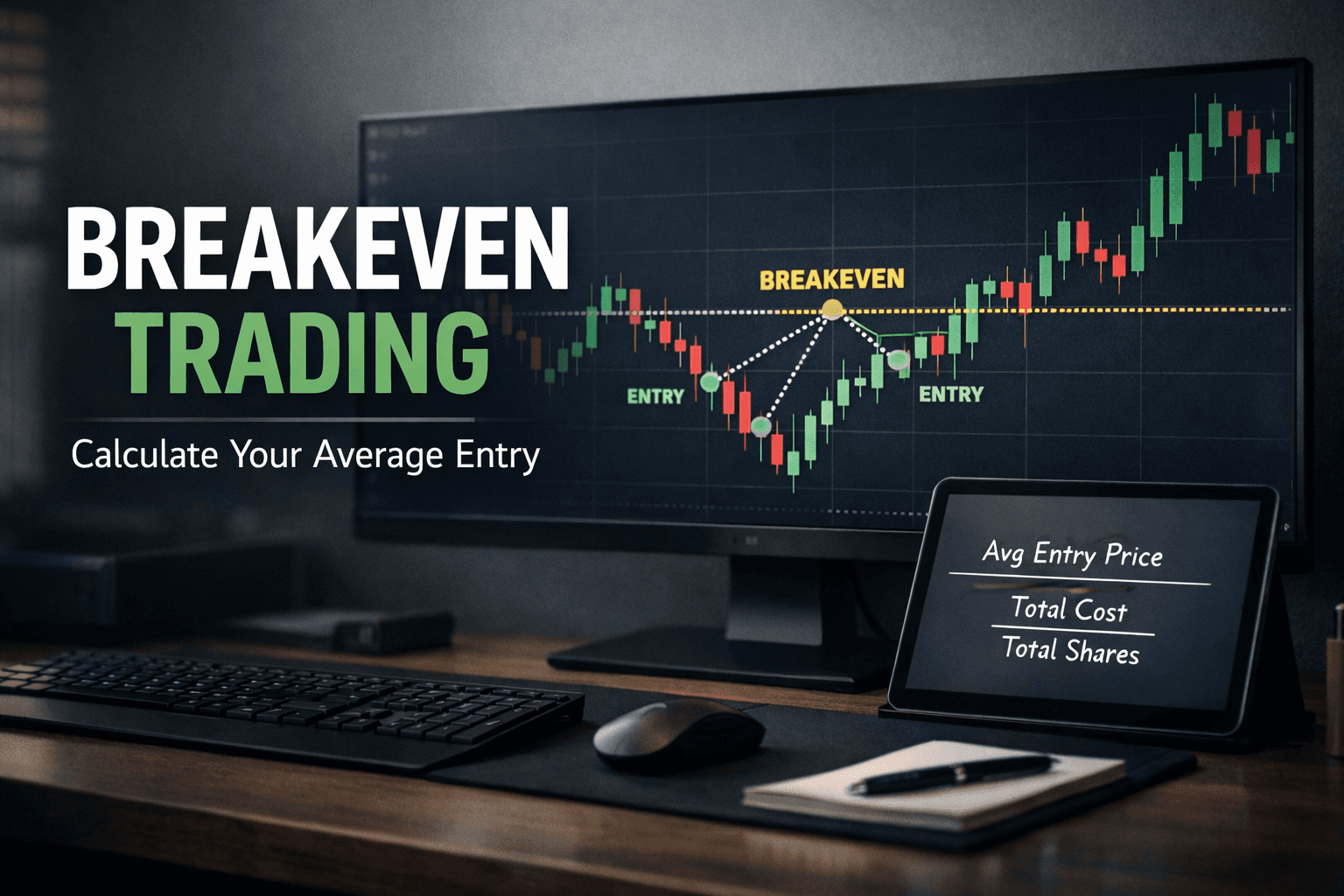
Breakeven Trading: How to Calculate Your Average Entry Price When Scaling Into Positions
Have you ever added to a winning trade to maximize profits? Or averaged down on a losing position hoping for a reversal? If so, you've practiced scaling—and understanding your breakeven point is crucial to doing it successfully.
In this beginner-friendly guide, we'll explain what breakeven means in trading, how to calculate your average entry price when scaling into positions, and how our free Breakeven Calculator can help you manage your trades more effectively.
What Does "Breakeven" Mean in Trading?
Your breakeven point is the price at which your trade would result in zero profit and zero loss. It's the exact price where you'd exit without gaining or losing any money (excluding spreads and commissions).
When you have a single entry, breakeven is simple—it's just your entry price. But when you scale into a position with multiple entries at different prices, your breakeven becomes a weighted average of all your entries.
What Is Scaling Into a Position?
Scaling (also called "averaging in" or "pyramiding") means entering a trade in multiple parts rather than all at once. There are two main approaches:
1. Scaling Into Winners (Pyramiding)
Adding to a position as it moves in your favor. This is generally considered the safer approach.
Example:
- First entry: Buy 0.05 lots at 1.0850
- Price moves to 1.0900 (in profit)
- Second entry: Buy 0.05 lots at 1.0900
2. Scaling Into Losers (Averaging Down)
Adding to a position as it moves against you. This is riskier but can lower your average entry price.
Example:
- First entry: Buy 0.05 lots at 1.0850
- Price drops to 1.0800 (in loss)
- Second entry: Buy 0.05 lots at 1.0800
Warning: Averaging down can be dangerous if the market continues moving against you. Always have a maximum position size and a final stop loss in mind.
How to Calculate Your Average Entry Price
When you have multiple entries, your average entry price is calculated using a weighted average formula:
Average Entry = (Price1 × Size1 + Price2 × Size2 + ...) / (Size1 + Size2 + ...)
Practical Example
Let's say you're trading EUR/USD and make these entries:
| Entry | Price | Lot Size |
|---|---|---|
| 1 | 1.0850 | 0.05 |
| 2 | 1.0820 | 0.05 |
| 3 | 1.0800 | 0.10 |
Calculation:
Average Entry = (1.0850 × 0.05 + 1.0820 × 0.05 + 1.0800 × 0.10) / (0.05 + 0.05 + 0.10)
Average Entry = (0.05425 + 0.0541 + 0.108) / 0.20
Average Entry = 0.21635 / 0.20
Average Entry = 1.08175
Your breakeven price is 1.08175. If the price reaches this level, you'll have zero profit/loss on the combined position.
Why Position Size Matters in the Calculation
Notice in the example above that the third entry had double the lot size (0.10 vs 0.05). This means it has more "weight" in the average calculation.
Key Insight: Larger positions pull the average price more strongly toward their entry price.
This is why traders sometimes add larger positions when they believe the price is at a better level—it has a bigger impact on the overall average.
Understanding "Pips to Breakeven"
Once you know your average entry price, you can calculate how far the current market price is from your breakeven point.
For a Long (Buy) Position:
- If current price > average entry → You're in profit
- If current price < average entry → You're in loss
- Pips to breakeven = (Current Price - Average Entry) / Pip Size
For a Short (Sell) Position:
- If current price < average entry → You're in profit
- If current price > average entry → You're in loss
- Pips to breakeven = (Average Entry - Current Price) / Pip Size
Example
Using our previous average entry of 1.08175 on EUR/USD (pip size = 0.0001):
- Current price: 1.0830
- Pips to breakeven: (1.0830 - 1.08175) / 0.0001 = 12.5 pips in profit
When Should You Scale Into Positions?
Good Reasons to Scale In:
- Reducing timing risk - Instead of trying to pick the perfect entry, you spread your entries across a range
- Building into winners - Adding to profitable trades as the trend confirms
- Planned averaging - Pre-determined levels where you'll add if price reaches them
- Dollar-cost averaging - Regular investments regardless of price (more common in investing than trading)
Bad Reasons to Scale In:
- Hoping a losing trade will reverse - Adding without a plan just to lower your average
- Emotional revenge trading - Doubling down because you "can't be wrong"
- No maximum position size - Scaling indefinitely until margin call
- Ignoring the overall trend - Averaging down against a strong trend
Risk Management When Scaling
Scaling adds complexity to risk management. Here are essential rules:
1. Define Your Maximum Position Size
Before your first entry, decide the maximum total position you're willing to hold. Never exceed this.
2. Set a Final Stop Loss
Know the price at which you'll exit the entire position, regardless of your average entry.
3. Calculate Total Risk
Your total risk = (Average Entry - Final Stop Loss) × Total Position Size
Make sure this doesn't exceed your per-trade risk limit (typically 1-2% of account).
4. Plan Your Entries in Advance
Don't make scaling decisions in the heat of the moment. Plan your entry levels and sizes before the trade.
How to Use the TradeLens Breakeven Calculator
Our free Breakeven Calculator makes managing scaled positions simple:
- Select your currency pair - The calculator knows the correct pip size
- Choose your direction - Long (buy) or Short (sell)
- Add your entry legs - Enter each entry price and lot size
- Enter current market price (optional) - To see pips to breakeven
The calculator instantly shows you:
- Weighted average entry price
- Total position size (in lots and units)
- Pips to breakeven from current price (if entered)
You can add as many entry legs as needed and remove any that you've closed.
Real-World Scaling Strategy Example
Here's how a disciplined trader might scale into a EUR/USD long position:
Setup:
- Identified support zone: 1.0800 - 1.0850
- Maximum position: 0.20 lots
- Final stop loss: 1.0750
- Target: 1.0950
Execution Plan:
| Entry Level | Lot Size | Running Total |
|---|---|---|
| 1.0850 | 0.05 | 0.05 |
| 1.0830 | 0.05 | 0.10 |
| 1.0810 | 0.05 | 0.15 |
| 1.0800 | 0.05 | 0.20 (max) |
If all entries fill:
- Average entry: 1.08225
- Risk to stop (1.0750): 72.5 pips
- Reward to target (1.0950): 127.5 pips
- R:R ratio: 1.76:1
If only first two entries fill:
- Average entry: 1.0840
- Smaller position but still valid trade
Common Questions About Breakeven
Q: Should I move my stop loss to breakeven?
Moving your stop to breakeven (your entry price) is a common technique to create a "free trade." However, doing it too early can result in getting stopped out before the trade has room to work.
Q: What if I partially close a position?
When you close part of your position, recalculate your average entry using only the remaining lots. Our calculator lets you remove entries to reflect partial closes.
Q: Is averaging down ever a good idea?
It can be, but only with strict rules: predetermined levels, maximum position size, and a final stop loss. Never average down hoping the market will reverse.
The Bottom Line
Understanding your breakeven point is essential when scaling into positions. Whether you're pyramiding into winners or carefully averaging into a support zone, knowing your exact average entry price helps you:
- Make informed decisions about adding to positions
- Set appropriate stop losses and take profits
- Calculate your true risk on the combined position
- Know exactly when you're in profit or loss
Our free Breakeven Calculator takes the math out of the equation, letting you focus on your trading decisions rather than manual calculations.
Managing a scaled position? Use our free Breakeven Calculator to instantly find your average entry price and see how far you are from breakeven.